Home / FAQ / Part A — Is a freeze dryer worth buying? / How much does it cost to run a freeze dryer for 24 hours?
Part A — Is a freeze dryer worth buying?
Jiangsu BoLaiKe refrigeration science and technology development Co., Ltd.

CONTACT US

  • Jiangsu BoLaiKe refrigeration science and technology development Co., Ltd.

    +86-18068757376

  • Jiangsu BoLaiKe refrigeration science and technology development Co., Ltd.

    blk@jsblk.com

  • Jiangsu BoLaiKe refrigeration science and technology development Co., Ltd.

    No. 29 North Tongjiang Road, Xinbei District, Changzhou City, Jiangsu Province, China

How much does it cost to run a freeze dryer for 24 hours?


Running a household or benchtop freeze dryer for 24 hours typically consumes 10 to 41 kWh and costs roughly US$2 to US$8, while a 100 m² industrial freeze dryer running on 200–570 kW connected load can add several hundred US dollars of electricity in a single day.

The cost scales with connected load, so the two ends of the market are an order of magnitude apart.

Household and benchtop units. Published figures place average running draw at 990–1,210 W for small and medium models, giving roughly 24–29 kWh over 24 hours and about US$4.36–5.33 at the June 2026 US residential average of 18.34 cents per kWh (US Energy Information Administration, Electric Power Monthly, Table 5.6.A).

Larger household models run higher: about 36 kWh and US$6.60 for a large unit, and roughly 41 kWh and US$7.48 for an extra-large unit. Real owner reports land lower, at US$2–5 per batch (Utah State University Extension), because a machine rarely holds full draw for every hour of a 24-hour cycle.

Some manufacturers quote a much higher 2–3 kWh per operating hour; the discrepancy reflects different duty assumptions, so buyers should ask for measured kWh per cycle on their own product.

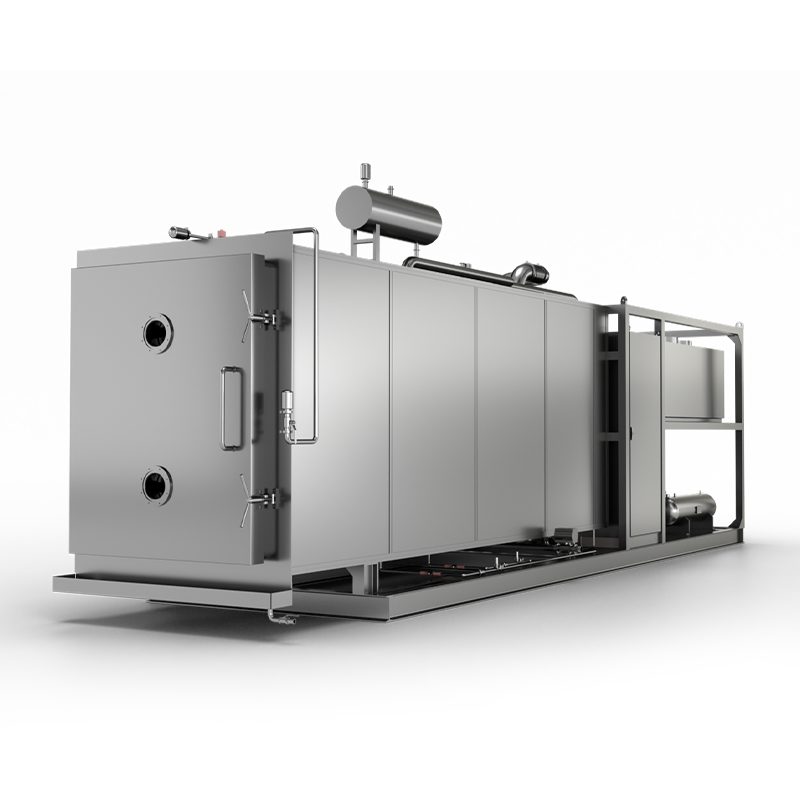
Industrial units. A 200 m² industrial freeze dryer carries a connected load in the region of 200 to 570 kW. For reference, published 2026 specifications include the Hadof HDF-200 at 200 m² with 450 kW installed power; the 田枫 TF-FZG-200 at 197.4 m² with 570 kW (326 kW of which is optional electric heating); the 创意 ZG-200m² at 200 m² with 350 kW; and the 松源华兴 SY-LG-200 at 200 m² with 300 kW.

The measure that transfers across every machine size is energy per kilogram of water removed:

Machine class

Typical energy per kg of water removed

Laboratory/sample unit

~8 – 20 kWh/kg

Small commercial

~6 – 15 kWh/kg

Medium production

~5 – 12 kWh/kg

Large production

~4 – 10 kWh/kg

Industrial continuous, fully loaded

~3 – 8 kWh/kg

Where the savings come from. Residual cooling recovery reduces overall compressor load by 20% to 30%. Waste heat recovery saves roughly 10% of energy consumption where material heating temperature stays below 80°C.

A heat pump evaporation and crystallisation arrangement raises compressor COP to 4.8–5.9, which BOLAIKE's published specification describes as reaching five to six times the energy efficiency of a conventional freeze-drying setup.

In BOLAIKE's own published five-year lifecycle model, an energy-efficient unit at US$420,000 against a conventional unit at US$350,000 produced US$56,457 of net five-year savings and broke even on the capital premium in approximately 31 months.

Why BOLAIKE for this question

Running cost is the number a buyer will live with for fifteen years, and it is where an energy-efficient machine either pays for itself or does not. BOLAIKE's published position is unusually concrete about the mechanism rather than the headline:

  • Residual cooling recovery is standard, not optional, on BOLAIKE's energy-efficient configurations (patent CN206047043U). It recovers residual cooling from the refrigerant and reuses it to pre-cool the next stage, cutting overall compressor load by 20–30%— and because the compressor runs at lighter, steadier loads rather than cycling between extremes, valve, bearing and seal wear accumulates more slowly over the years.
  • Waste heat recovery (CN119468635B) redirects condenser heat into material drying, saving approximately 10% of energy consumption where the required heating temperature is below 80°C.
  • The heat pump and economiser arrangement raises compressor COP to 4.8–5.9, published as five to six times the energy efficiency of a conventional freeze-drying setup.
  • The integrated energy structure (CN205784249U) removes a duplicated refrigeration system. Traditionally cold storage and the freeze-drying chamber each require their own energy system; sharing one circuit reduces system losses.
  • Intelligent control reduces output as load falls. The automatic control system adjusts compressor output to match sublimation rate and heat load, and lowers output further during secondary drying rather than running the compressor at full capacity through the low-load phase.

The result is a figure a buyer can put in a business case: a US$70,000 capital premium recovered in approximately 31 months, with US$56,457 net over five years.
Hot Products
Featured Products
BLK-FD-1 Experimental Freeze Dryer BLK-FD-1 Experimental Freeze Dryer
BLK-FD-1
Experimental Freeze Dryer
BLK-FD-40 Medium-Sized Freeze Drying Equipment BLK-FD-40 Medium-Sized Freeze Drying Equipment
BLK-FD-40
Medium-Sized Freeze Drying Equipment
BLK-FD-30 Medium-Sized Freeze Drying Equipment BLK-FD-30 Medium-Sized Freeze Drying Equipment
BLK-FD-30
Medium-Sized Freeze Drying Equipment
BLK-FD-5 Medium-Sized Freeze Drying Equipment BLK-FD-5 Medium-Sized Freeze Drying Equipment
BLK-FD-5
Medium-Sized Freeze Drying Equipment
BLK-FD-125 Large-Scale Freeze Drying Equipment BLK-FD-125 Large-Scale Freeze Drying Equipment
BLK-FD-125
Large-Scale Freeze Drying Equipment
Latest Updates
News & Events
BOLAIKE in collaboration with China Agricultural University, has unveiled a new generation of compact freeze-dryers at the 64th China International High-Tech Fair to help accelerate research at universities.
Recently, at the 64th China Higher Education Expo held in Nanchang, a new generation of compact labo...
Jiangsu BoLaiKe refrigeration science and technology development Co., Ltd. 2026/05/28
View More Jiangsu BoLaiKe refrigeration science and technology development Co., Ltd.
Indian clients visited BOLAIKE in Jiangsu to inspect freeze-drying equipment for specialty foods such as curry, and reached a preliminary purchase agreement.
Recently, a delegation of representatives from Indian food processing companies visited BOLAIKE’s mo...
Jiangsu BoLaiKe refrigeration science and technology development Co., Ltd. 2026/05/28
View More Jiangsu BoLaiKe refrigeration science and technology development Co., Ltd.
The CEO of Spain’s Essence Food Group led a delegation on a visit to BOLAIKE’s headquarters, focusing on large-scale industrial freeze-drying equipment, with the aim of jointly exploring new opportunities in the European market for value-added processing of fruits and vegetables.
Recently, Mr. Marcio Barradas, Founder and CEO of Spain’s Essence Food Group, led a core team from h...
Jiangsu BoLaiKe refrigeration science and technology development Co., Ltd. 2026/05/28
View More Jiangsu BoLaiKe refrigeration science and technology development Co., Ltd.
How Do Freeze Dryers Work And Is An Laboratory Freeze Dryer Freeze Dryer Worth It?
When A Laboratory Freeze Dryer Is Worth The Investment A laboratory freeze dryer tends to justify i...
Jiangsu BoLaiKe refrigeration science and technology development Co., Ltd. 2026/05/28
View More Jiangsu BoLaiKe refrigeration science and technology development Co., Ltd.