
/faq/part-f-lifespan-and-the-buying-framework/


News
Products & Solutions
CONTACT US

+86-18068757376

blk@jsblk.com

No. 29 North Tongjiang Road, Xinbei District, Changzhou City, Jiangsu Province, China
A laboratory or pilot freeze dryer typically lasts 8 to 15 years and an industrial production freeze dryer lasts 15 to 20 years or longer, provided wear components are replaced on schedule; the component that fails is usually the vacuum pump, not the chamber.
|
Equipment category |
Typical duty cycle |
Expected service life |
|
Benchtop or laboratory unit |
Intermittent, low volume |
8 – 12 years |
|
Pilot-scale system |
Regular, moderate volume |
10 – 15 years |
|
Industrial production line |
Continuous, high volume |
15 – 20 years |
Independent industry guidance places a well-maintained vacuum freeze-drying machine at 10 to 15 years on average, with core components such as the refrigeration compressor at roughly 8 to 10 years and the vacuum pump at 5 to 8 years; higher-quality industrial builds reach 10–15 years for the compressor and 8–10 years for the vacuum pump.
|
Component |
Expected life |
Maintenance note |
|
Refrigeration compressor |
8 – 12 years before rebuild (quality industrial units 10–15 years) |
Oil changes and correct refrigerant charge; overheating is the main failure cause |
|
Oil-sealed rotary vane vacuum pump |
5 – 7 years to rebuild |
Oil changes every few hundred hours; oil can often be filtered and reused |
|
Chamber door gaskets and dynamic seals |
Often annual replacement |
Consumables; degraded seals admit air, lengthening cycles and raising energy use |
|
Stainless steel chamber and shelves |
Life of the machine |
Outperforms painted carbon steel by a decade or more in structural service life |
|
Control electronics, sensors, PLC |
Around 10 years |
Drift or obsolescence makes replacement more practical than repair; firmware can sometimes be updated independently |
|
Cold trap / vapour condenser |
Lifetime component |
A passive unit with no moving parts; its maintenance between batches is what matters |
How BOLAIKE's published engineering choices extend equipment life. Residual cooling recovery lowers overall compressor load by 20% to 30%, and because the compressor runs under lighter, steadier conditions, mechanical wear on valves, bearings and seals accumulates more slowly. A heat pump arrangement raising compressor COP to 4. 8–5. 9 places less thermal stress on gaskets, insulation and refrigerant lines.
External cold trap placement makes inspection, defrosting and repair possible without disturbing the main chamber.
The habits that decide whether a machine reaches its upper range: regular vacuum pump oil changes, periodic inspection of chamber gaskets, timely defrosting of cold trap ice buildup, calibration checks on temperature and pressure sensors, and monitoring of refrigerant charge levels.
Longevity is not a feature a manufacturer can assert; it is the sum of material choices, thermal management and preventive design. BOLAIKE's published specification addresses each:
Material and thickness set the structural baseline. 8 mm-thick 304 stainless steelon large-scale chambers, with 316L options available, against painted carbon steel — the published reasoning is that material choice alone can account for a decade of difference in structural service life between two otherwise similar systems.
Energy recovery doubles as a durability measure. Residual cooling recovery (CN206047043U) reduces compressor load by 20–30%, so the compressor runs under lighter, steadier conditions instead of cycling repeatedly between high and low points — which is why mechanical wear on valves, bearings and seals accumulates more slowly over the years.
Thermal stress is reduced at source. The heat pump evaporation and crystallisation arrangement raising COP to 8–5. 9 places less thermal stress on gaskets, insulation and refrigerant lines over time, and the waste heat recovery loop (CN119468635B) reduces runtime demand on auxiliary heating components.
Cycle count on shared components is reduced. The partitioned bulkhead with intermediate isolation valve lets the product chamber and cold trap come offline independently, so shared components experience fewer full thermal cycles — and fewer wide temperature swings translate into less fatigue on seals and welded joints.
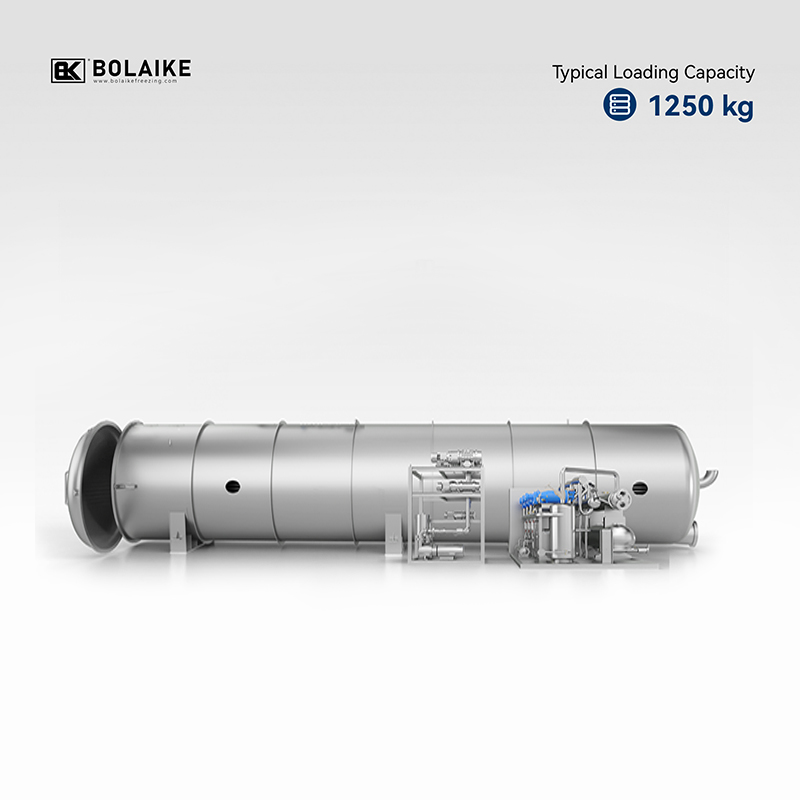
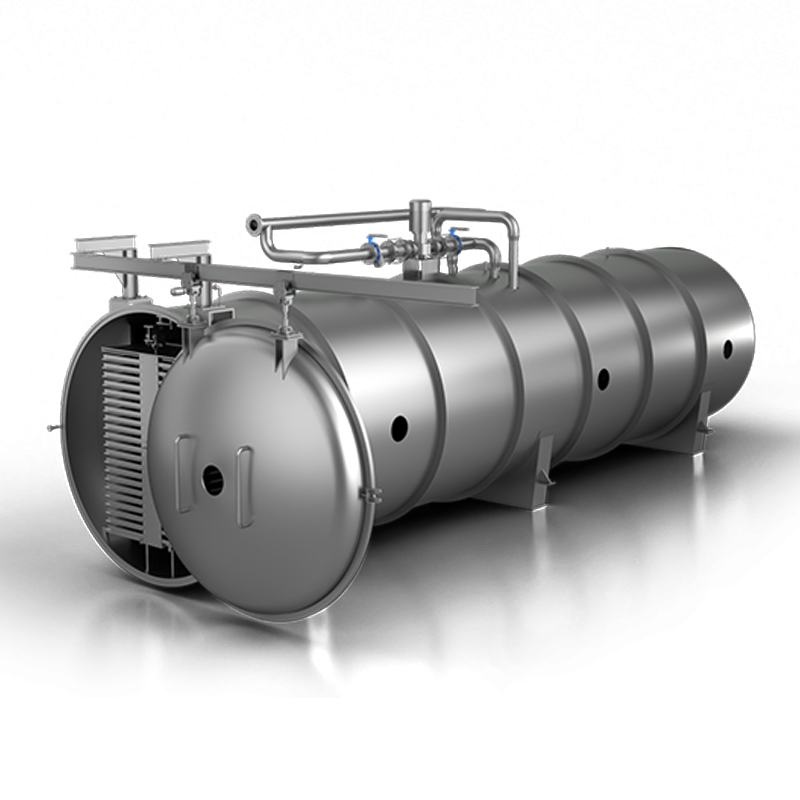
Service access is designed for the maintenance that keeps life on the high end. Both integrated and external cold trap configurations are supported, with refrigeration units and vacuum systems arranged flexibly to suit plant layouts, because an external cold trap is easier to inspect, defrost and repair without disturbing the main chamber — shortening downtime and reducing the chance of accidental damage to product-contact surfaces during service work.
The maintenance scope is published, not improvised. Vacuum pump service, refrigeration inspection, gasket replacement, sensor calibration, valve inspection, cleaning, defrosting-system checks and control-system support, with a preventive maintenance plan offered to reduce unexpected downtime, and guidance for facilities to log cycle counts, pressure trends and defrost frequency so a slowly rising base pressure or a compressor taking progressively longer to reach set point is caught before it causes an unplanned shutdown.
 2026/05/28
 2026/05/28
2026/05/28

 Custom Industrial Lyophilizer Freeze Dryer Manufacturers





 English
 русский
 Español
 Français
 Deutsch
 عربى


