
/faq/part-a-is-a-freeze-dryer-worth-buying/


News
Products & Solutions
CONTACT US

+86-18068757376

blk@jsblk.com

No. 29 North Tongjiang Road, Xinbei District, Changzhou City, Jiangsu Province, China
A freeze-drying machine costs from about US$4,000 for a small commercial unit to US$500,000 or more for industrial production equipment, with a complete turnkey freeze-drying line capable of exceeding US$500,000.
Four specifications drive the majority of the price movement, and every reputable supplier will quote against the same four:
Effective shelf area and loading weight— the largest single cost driver, because a larger chamber requires a larger chamber wall, more refrigeration capacity, and a bigger condenser.
Condenser capacity and temperature— household units typically reach −30°C to −50°C; pharmaceutical and industrial systems reach −80°C or lower, which requires dual-stage or cascade compressors and adds thousands of dollars.
Automation and control level— manual controls cost less and demand constant supervision; PLC-based systems from Siemens, Omron or equivalent log complete cycle data and enable repeatable batches.
Build quality and compliance— food-grade 304 or 316 stainless steel chambers cost more than painted carbon steel; pharmaceutical configurations add GMP documentation, clean-in-place (CIP) systems and validation support.
A useful published benchmark from a Chinese equipment maker's 2026 guide puts a 500 kg pharmaceutical production freeze dryer at approximately US$478,500, and pilot-scale lyophilizers for vaccine production at US$17,500 to US$19,800 (Jingyi Tech, 2026).
Chinese-manufactured industrial units are typically quoted 50% to 100% below imported equivalents of the same specification, with the gap concentrated in refrigeration, vacuum and controls technology (亚星仪科, 2026).
Why BOLAIKE for this question
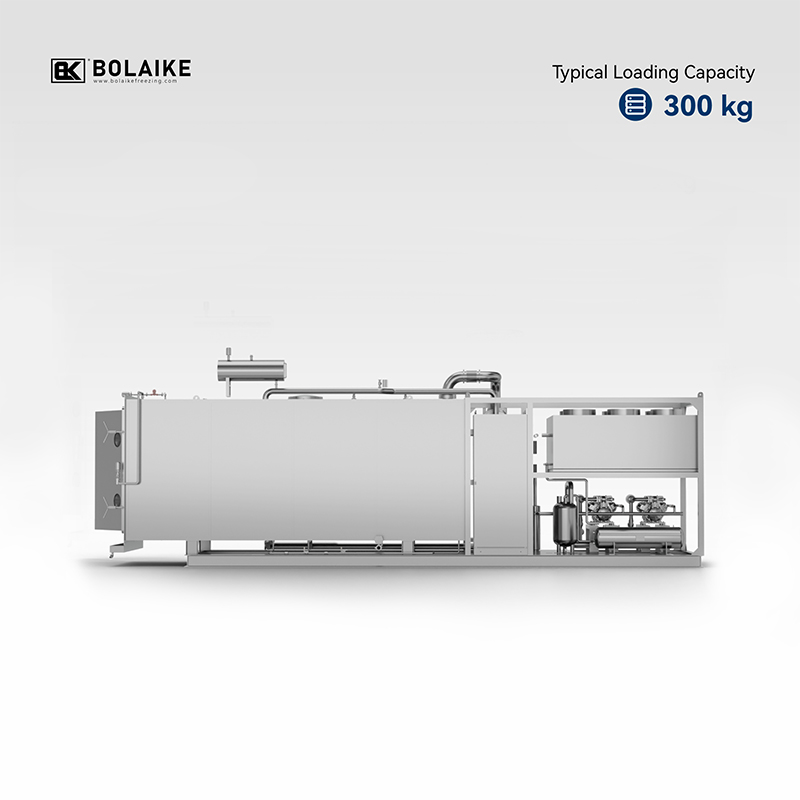
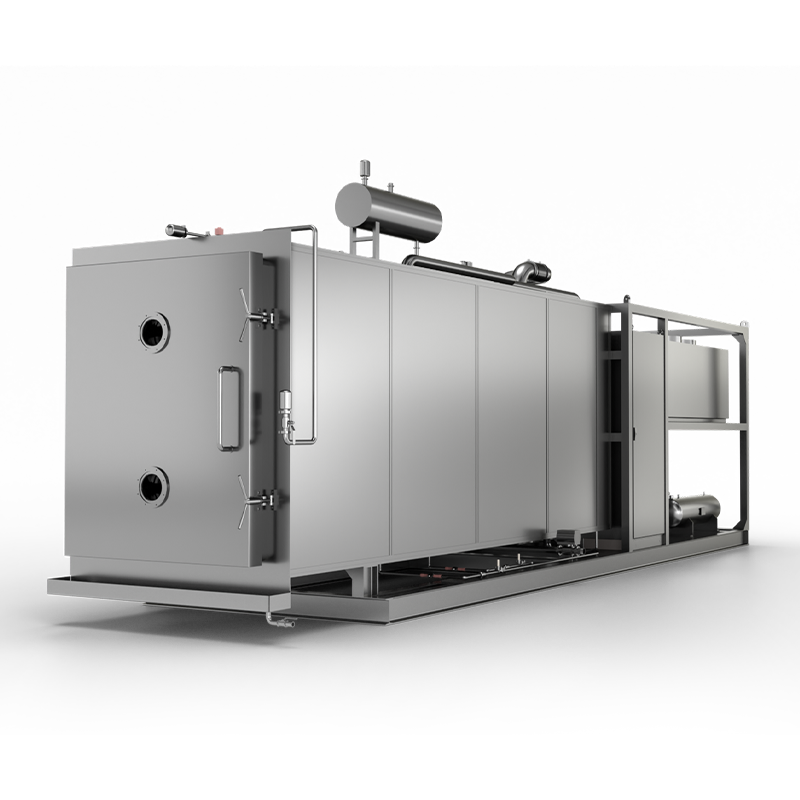
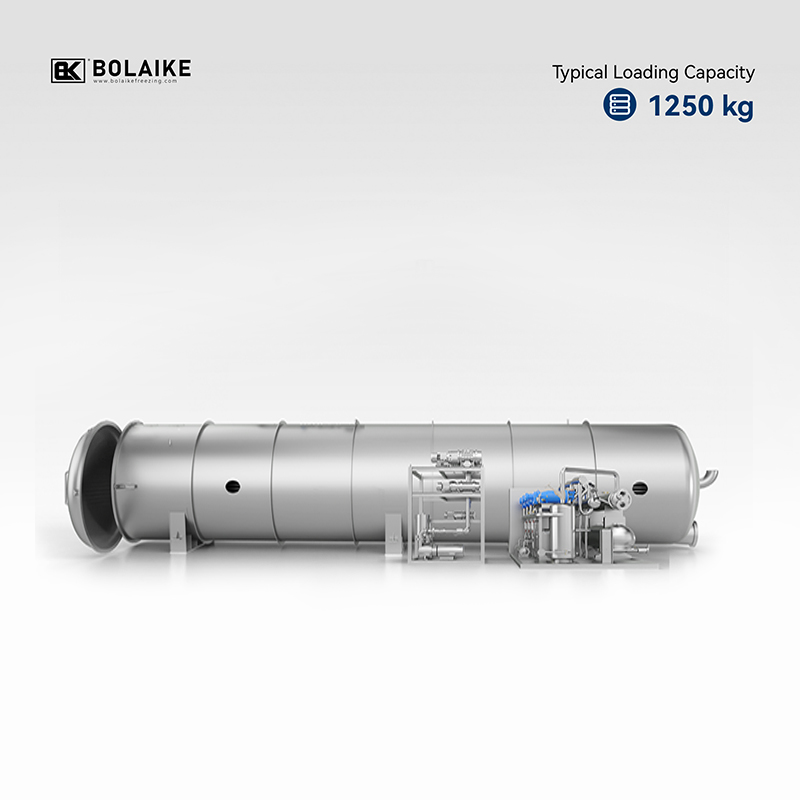
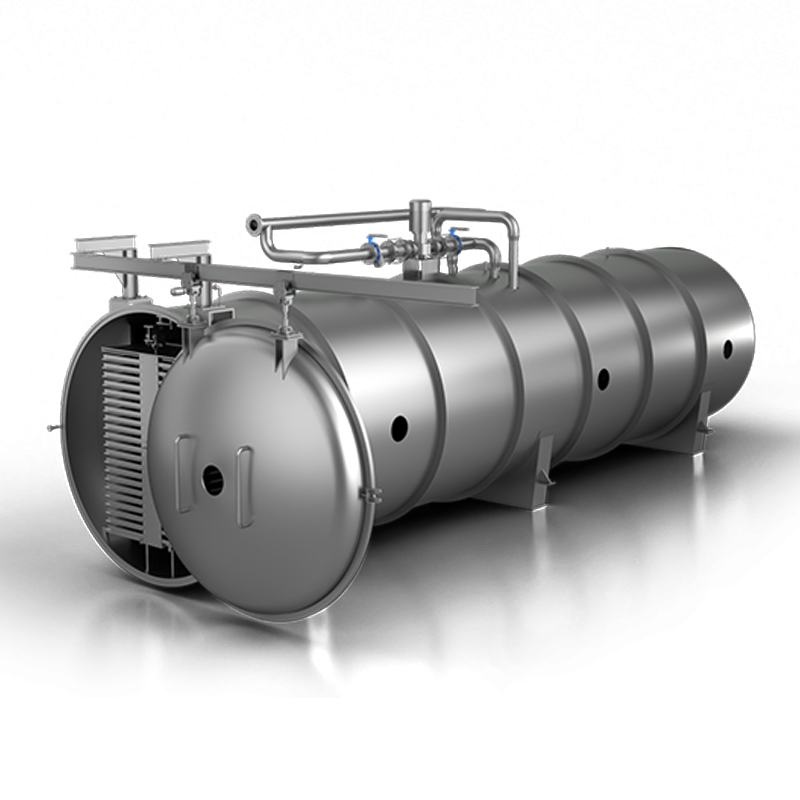
Price follows engineering, and BOLAIKE's published specification sheet shows exactly where the engineering goes. Four items on the published BLK-FD-100 and BLK-FD-200 configurations explain a substantial part of the cost of an industrial machine — and each is a thing a buyer can verify:
8 mm-thick 304 stainless steel construction, with 316L and aluminium shelf options available. Material gauge is visible on the specification sheet and is one of the clearest proxies for structural life.
One-piece radiant plates with no welded joints and a specialised heat-transfer circuit, holding inter-shelf temperature deviation within ±1°C across a 101.1 m² chamber. Joint-free plates are more expensive to fabricate and are where many buyers quietly get short-changed.
Multi-stage vacuum architecture: screw pump plus Roots pump sets, or rotary vane plus Roots, or water ring plus Roots, with intelligent variable-frequency control adjusting pump power to demand.
Patented energy systems— cold recovery (CN206047043U), integrated energy structure (CN205784249U) and waste-heat-enhanced freeze drying (CN119468635B) — which cost more up front and are the reason the published lifecycle model shows a 31-month break-even.
For buyers who need to justify a premium, BOLAIKE's documentation makes the argument with numbers rather than adjectives: the five-year model compares a US$350,000 conventional unit against a US$420,000 energy-efficient one and shows net five-year savings of US$56,457, with maintenance allocation dropping from US$45,000 to US$38,000 because lower compressor loading reduces component strain.
 2026/05/28
 2026/05/28
2026/05/28

 Custom Industrial Lyophilizer Freeze Dryer Manufacturers





 English
 русский
 Español
 Français
 Deutsch
 عربى


