
/news/news-media/


News
Products & Solutions
CONTACT US

+86-18068757376

blk@jsblk.com

No. 29 North Tongjiang Road, Xinbei District, Changzhou City, Jiangsu Province, China
A practical, data-backed reference for engineers and procurement teams evaluating industrial lyophilizers for pharmaceutical, food, and biotechnology production.
For production volumes above roughly fifty kilograms of finished product per batch, a tray style or shelf style industrial freeze dryer with automated loading, a multi stage vacuum system, and a condenser capacity of at least one hundred fifty kilograms of ice holding capacity is the right starting point for most pharmaceutical, biotech, and premium food manufacturers. Below that volume, a mid size cabinet unit is usually more cost effective. The equipment choice that fits your operation depends on four factors that matter more than any brand name: batch size and required throughput, the physical and chemical properties of the product being dried, the level of automation and data logging required for regulatory compliance, and the total cost of ownership over a ten year equipment life, not just the purchase price. The sections below break down each of these factors with real numbers, comparison tables, and a step by step selection checklist you can apply directly to your own production plan.
Understanding the process before the machine helps you specify the right system the first time.
Freeze drying, also called lyophilization, removes water from a product by freezing it solid and then reducing the surrounding pressure so the frozen water turns directly into vapor without passing through a liquid phase. This process happens in three stages. The freezing stage cools the product below its eutectic or collapse temperature, usually between minus thirty and minus fifty degrees Celsius. The primary drying stage applies a vacuum, typically between zero point one and one millibar, while gently warming the shelves so the ice sublimates and travels to a much colder condenser surface. The secondary drying stage raises the shelf temperature further to remove any remaining bound moisture that did not leave as ice.
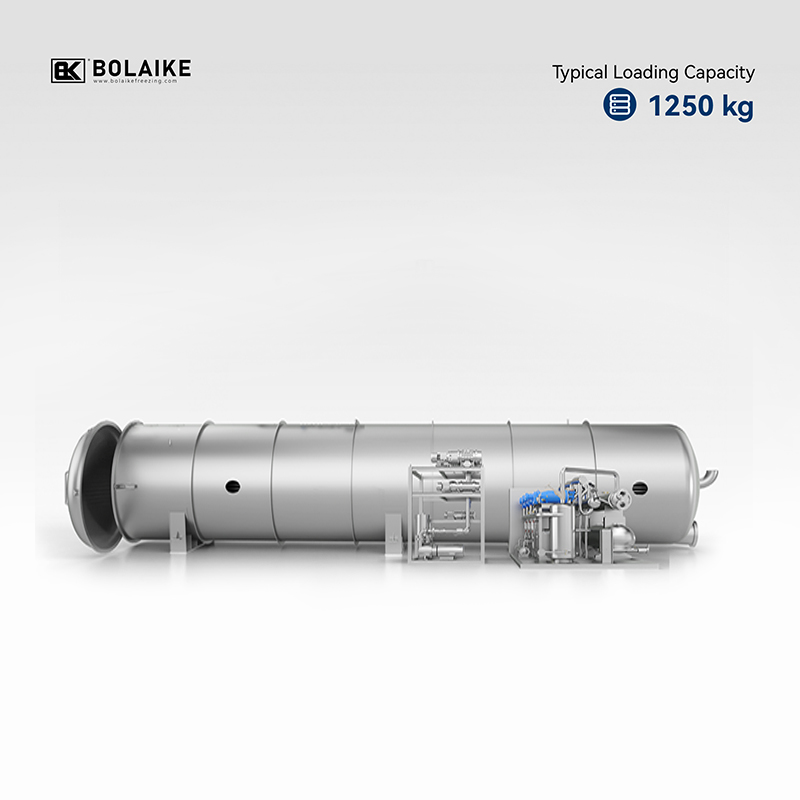
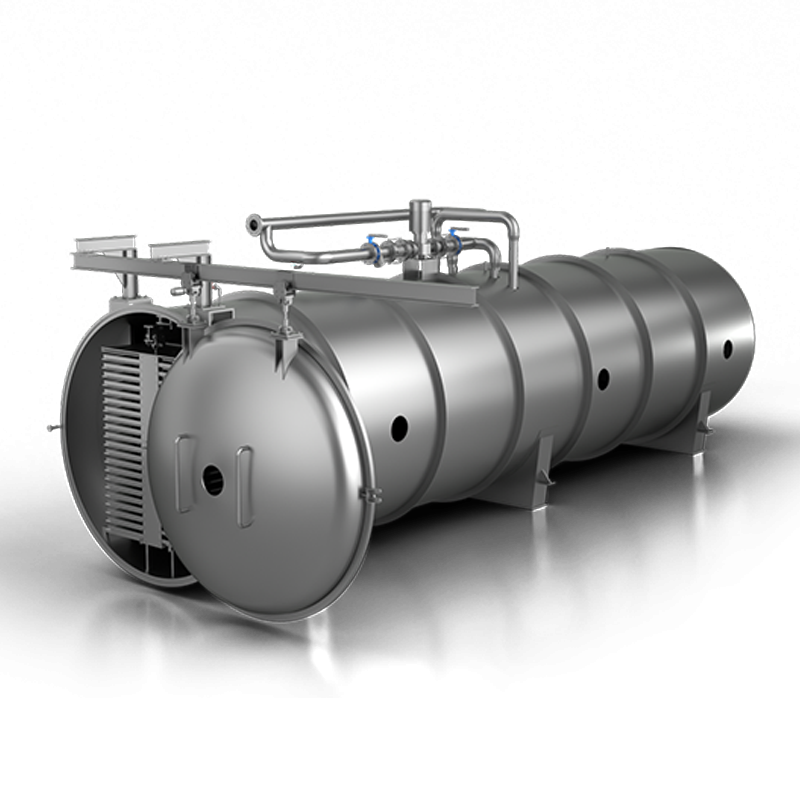
Large-scale freeze drying equipment refers to industrial systems built to run this process on production volumes far beyond a laboratory bench top unit. Where a lab freeze dryer might handle a few liters per cycle on a shelf area under one square meter, industrial systems are built around chambers with shelf areas ranging from roughly ten square meters in a mid size pharmaceutical line to over one hundred fifty square meters in the largest food and biologics plants. A mid size industrial freeze dryer commonly processes between five hundred and two thousand liters of liquid product per batch, while the largest installations used by major vaccine manufacturers and bulk food processors can exceed several thousand liters per cycle.
The defining characteristic of large-scale equipment is not just size, it is the engineering required to keep every point on a large shelf surface at a uniform temperature and pressure. A one square meter lab unit has almost no shelf-to-shelf variation to manage. A one hundred square meter industrial chamber requires precise refrigerant distribution, multiple independent shelf zones, and a control system that can compensate for small differences in heat transfer across the chamber. This is why industrial freeze dryers cost substantially more per unit of shelf area than lab equipment, and why choosing the right configuration matters so much for production consistency.
It helps to place large-scale equipment on a spectrum. Bench top and laboratory units serve formulation development and early stage trials, typically with a shelf area under two square meters and no requirement for uniform multi zone temperature control. Pilot scale units, often between two and ten square meters of shelf area, bridge development and commercial production, letting a manufacturing team confirm that a cycle developed at lab scale still produces an acceptable product when batch size increases. Full commercial scale equipment, starting around ten square meters and extending past one hundred fifty square meters in the largest installations, is engineered from the ground up for repeatable, validated, high volume output rather than experimentation. Buyers sometimes try to skip the pilot stage to save time, but this frequently causes cycle failures once a formulation reaches full commercial shelf area, since heat and mass transfer behavior does not always scale linearly with chamber size.
Shelf loading density is another factor worth understanding early. Vial based pharmaceutical products are loaded at a fixed number of vials per shelf, determined by vial diameter and required spacing for uniform heat transfer, commonly between two hundred and four hundred vials per square meter for standard five to ten milliliter vials. Bulk tray products, by contrast, are loaded by fill depth, and a deeper fill reduces the effective drying rate because sublimating vapor has to travel further through the partially dried product layer to escape. Confirming your expected loading density before finalizing shelf area prevents a common and costly surprise, which is discovering that a chamber sized correctly for total volume cannot actually fit the required number of vials or trays per cycle.
Five equipment categories cover almost all industrial applications. Each is built around a different loading method and product form.
Choosing between these categories starts with the physical form of the product rather than the industry label. A liquid product filled into individual containers before drying, such as an injectable vaccine or a diagnostic reagent, almost always calls for a tray and shelf design, since each container needs to sit on a temperature controlled surface throughout the cycle. A loose or granular product, such as coffee extract or diced fruit, does not need individual containers and can be processed more efficiently in a rotary drum, which tumbles the product for more even exposure to heat and vacuum. Fine particle products destined for encapsulation or blending, such as flavor concentrates and probiotic strains, are often better served by spray freeze drying, which produces a controlled particle size distribution during the freezing step itself rather than requiring separate milling after drying.
| Equipment Type | Typical Batch Capacity | Best Suited For | Typical Shelf or Chamber Size | Approximate Cycle Time |
| Tray and Shelf Freeze Dryer | 500 to 5000 liters | Injectable drugs, vaccines, vials, and packaged food trays | 10 to 150 square meters | 24 to 72 hours |
| Manifold and Bulk Freeze Dryer | 200 to 1500 liters | Bulk powders, flasks, and non-vial liquid products | 5 to 40 square meters | 18 to 48 hours |
| Rotary Drum Freeze Dryer | 1000 to 8000 liters per day | Instant coffee, fruit pieces, pet food, and granular food products | Drum volume 2 to 20 cubic meters | 8 to 20 hours per drum cycle |
| Spray Freeze Dryer | Continuous feed, 50 to 500 kg per hour | Flavors, probiotics, and fine particle nutraceutical powders | Chamber volume 1 to 10 cubic meters | Continuous, minutes per particle pass |
| Continuous Freeze Dryer Line | 2000 to 10000 liters per day | High volume vaccine fill finish and large scale biologics | Modular tunnel, custom length | Continuous, hours per module pass |
A useful rule when narrowing between tray and shelf systems and rotary drum systems is to check whether the finished product needs to retain a specific shape or fill volume per unit, such as a vial or a pre-portioned tray. If shape and unit dosing matter, a tray and shelf system is almost always the correct choice regardless of throughput target. If the product is sold or further processed as loose granules, flakes, or powder, a rotary drum or continuous line typically achieves higher throughput per square meter of factory floor space and lower cost per kilogram of finished product.
Six components determine performance, reliability, and regulatory readiness regardless of equipment type.
These six systems work together during every cycle, and a weakness in any single one limits the performance of the whole machine. A powerful vacuum system paired with an undersized condenser will still fail to dry a batch fully, because vapor generated faster than the condenser can capture it raises chamber pressure and slows sublimation. Similarly, a well sized refrigeration system paired with a control system that cannot log data to the standard required by your regulator will pass every physical test and still fail a compliance audit. Evaluating equipment means checking each of the six systems against your specific requirements individually, not assuming that a strong headline specification on one system compensates for a weaker one elsewhere.
Stainless steel shelves circulate a heat transfer fluid that can both cool the product to freezing temperatures and later warm it during drying. Shelf temperature uniformity within plus or minus one degree Celsius across the full chamber is the benchmark for pharmaceutical grade equipment.
Rotary vane or dry screw vacuum pumps pull the chamber down to sub-millibar pressure and hold it there for the full cycle. Larger systems use two or three pumps in sequence, with a roots booster stage to reach deep vacuum faster on large chamber volumes.
The condenser is a refrigerated surface, usually held between minus fifty and minus eighty degrees Celsius, that captures the water vapor leaving the product as ice. Its ice holding capacity, measured in kilograms, must exceed the total water content of the batch with a safety margin, typically twenty to thirty percent above calculated batch water load.
A programmable logic controller or full SCADA platform manages the recipe, records shelf temperature and chamber pressure every few seconds, and produces the audit trail records required for regulated industries. Systems intended for pharmaceutical use are built to support twenty one CFR part eleven electronic record requirements.
Chambers are built from 316L stainless steel with polished interior surfaces to meet cleanability standards. Loading can be manual cart loading, semi-automated loading trolleys, or a fully automatic loading and unloading system that transfers vials directly from a filling line without operator contact.
Pharmaceutical grade units include built in clean in place and steam in place circuits so the chamber can be sanitized between batches without disassembly, a requirement for aseptic vaccine and biologic production.
The same underlying process serves very different products, and each industry drives different equipment requirements.
| Industry | Typical Product | Key Equipment Requirement | Relevant Standard |
| Pharmaceutical | Vaccines, injectable biologics, antibiotics | Aseptic loading, clean in place, full data logging | cGMP, FDA 21 CFR, EU GMP Annex 1 |
| Food and Beverage | Instant coffee, fruit, ready meals, pet food | High throughput, rotary or tray systems, food contact materials | HACCP, FDA food safety rules |
| Biotechnology | Cell cultures, enzymes, diagnostic reagents | Precise low temperature control, small batch flexibility | ISO 13485 for diagnostics manufacturing |
| Nutraceuticals | Probiotics, vitamin blends, protein powders | Gentle drying to preserve live cultures and potency | GMP for dietary supplements |
| Cosmetics | Active ingredient concentrates, sheet mask serums | Batch flexibility, moderate throughput | ISO 22716 cosmetic GMP |
Pharmaceutical and biotechnology applications place the heaviest documentation burden on equipment, since every batch record must trace shelf temperature, chamber pressure, and cycle timing for regulatory submission and post market surveillance. This typically means specifying equipment with continuous data logging at intervals of ten seconds or less, tamper evident electronic records, and validated sensor calibration certificates. Food and beverage applications generally prioritize throughput and total cost per kilogram of finished product over documentation depth, though HACCP based food safety plans still require basic batch traceability and temperature logging.
Nutraceutical and cosmetic applications occupy a middle ground, often requiring GMP documentation similar to food safety standards but with additional attention to preserving biological activity, since probiotic strains and active cosmetic ingredients can lose potency if shelf temperature ramps too aggressively during primary drying. Buyers in these industries frequently specify slower, more conservative temperature ramp profiles even though this extends cycle time, because product potency after drying is the primary quality metric rather than raw throughput.
Work through these eight factors in order. Each one narrows the field of suitable equipment before you request quotes.
Most procurement teams make the mistake of starting the selection process by contacting vendors and comparing quoted prices for similar sounding chamber sizes. This approach almost always leads to comparing equipment that is not actually equivalent, since two vendors quoting a forty square meter chamber can differ enormously in condenser capacity, automation level, and validation support included in the base price. Working through the eight factors below before contacting any vendor produces a specification document you can send to multiple manufacturers, which makes quotes genuinely comparable and shortens the overall selection timeline.
Once you have answers to all eight factors, you should be able to write a one page equipment specification covering required shelf area, condenser capacity, shelf temperature range, automation level, and documentation requirements. Sending this specification to three or more manufacturers, rather than asking each one to propose their own configuration, is the single most effective way to get comparable quotes and avoid discovering mid negotiation that two seemingly similar quotes actually cover very different equipment.
Sizing equipment correctly starts with translating your production target into shelf area and cycle time.
Shelf area drives everything else in equipment sizing. A general planning rule used across the industry is that one square meter of shelf area holds between fifteen and twenty five liters of fill volume, depending on vial size and fill depth. A facility that needs to produce one million vials per year at five milliliters per vial requires roughly five thousand liters of total annual fill volume. If the site runs one batch every three days, accounting for cleaning and changeover time, that is approximately one hundred usable batch days per year, meaning each batch needs to process about fifty liters, which fits comfortably on a three to four square meter shelf area unit. Scaling this same logic to a facility producing fifty million vials per year quickly points toward the largest available industrial chamber sizes above one hundred square meters.
Condenser sizing follows directly from batch water content. A general estimate is that dry product represents somewhere between ten and forty percent of the original wet product mass, meaning the remainder is water that must be captured by the condenser during the cycle. A one thousand liter batch of a product that is eighty percent water by weight generates approximately eight hundred kilograms of water vapor over the full cycle, which is why large condensers are commonly specified at one hundred fifty to three hundred kilograms of ice holding capacity, giving enough margin to avoid condenser saturation before the cycle completes.
This example illustrates a broader planning principle. Once required shelf area calculations point past roughly one hundred fifty square meters for a single chamber, most experienced buyers and equipment manufacturers recommend splitting production across two or more parallel units rather than requesting a single oversized custom chamber. Parallel units cost somewhat more in total floor space and duplicate utility connections, but they eliminate the single point of failure risk of relying on one chamber for all production, and they allow gradual capacity expansion by adding one additional unit at a time as demand grows.
Purchase price is typically only forty to fifty percent of the ten year total cost of owning large-scale freeze drying equipment.
Building an accurate total cost of ownership model before committing to a purchase requires input from several departments, not just procurement. Facilities teams can confirm actual local electricity and water rates rather than relying on vendor provided national averages, which often understate true operating cost in regions with higher utility pricing. Quality and regulatory teams can estimate validation cost based on your specific product portfolio, since a facility running a single validated product will spend proportionally less on validation than one running many different formulations through the same chamber. Finance teams can model financing cost if the equipment is leased rather than purchased outright, which shifts the cost distribution across categories significantly.
| Cost Category | Approximate Share of 10 Year Total Cost | Notes |
| Equipment Purchase Price | 35 to 45 percent | Scales strongly with shelf area and automation level |
| Installation and Facility Preparation | 8 to 12 percent | Includes utility connections, cleanroom integration, rigging |
| Utilities, Electricity and Cooling Water | 15 to 20 percent | Largest recurring operating cost over equipment lifetime |
| Validation and Qualification | 5 to 8 percent | Higher for regulated pharmaceutical applications |
| Maintenance and Spare Parts | 12 to 18 percent | Includes vacuum pump service and gasket replacement |
| Operator Training and Staffing Support | 4 to 6 percent | Recurring cost as staff turnover requires retraining |
Buyers who evaluate equipment purchase price in isolation frequently underestimate total cost by thirty to fifty percent. A lower priced unit with an inefficient refrigeration system or an undersized condenser can cost more over ten years in electricity and unplanned downtime than a higher priced unit built with modern variable speed compressors and a properly sized condenser. Requesting documented energy consumption figures per cycle from each vendor, not just nameplate power ratings, is one of the most reliable ways to compare true operating cost across competing equipment options.
Some manufacturers offer leasing or equipment financing arrangements that reduce upfront capital requirements at the cost of higher total spend over the equipment lifetime, similar to financing arrangements in other categories of industrial capital equipment. This can make sense for growing companies that need production capacity immediately but want to preserve cash for other expansion needs, though it is worth confirming whether a financing arrangement includes maintenance and service coverage or whether that remains a separate ongoing cost. Buyers should also ask whether a vendor offers a buy back or trade in program, since some manufacturers will credit a portion of an older unit toward a larger replacement system once production volume grows beyond the original equipment capacity.
A structured maintenance schedule is the single biggest factor in avoiding unplanned downtime on large freeze drying systems.
Unplanned downtime on a large freeze dryer is expensive in a way that is easy to underestimate before it happens. A single lost batch on a large pharmaceutical chamber can represent hundreds of thousands of dollars in raw material and lost production capacity, and a failure that occurs mid cycle can also require full chamber requalification before production resumes, adding weeks rather than days to the recovery timeline. The maintenance schedule below reflects practices used across established pharmaceutical and food manufacturing sites, and it is worth building into a preventive maintenance contract with either the equipment vendor or a qualified third party service provider rather than relying entirely on internal staff for the more specialized annual tasks.
Facilities that track maintenance history digitally, rather than on paper logs, gain an additional benefit beyond compliance record keeping. Trend data across multiple years of shelf temperature uniformity checks and vacuum leak rate readings often reveals gradual equipment degradation well before it becomes a production problem, giving maintenance teams time to schedule a repair during planned downtime rather than responding to an unplanned failure mid batch.
Most equipment sizing problems trace back to one of these five decisions made early in the buying process.
Each of the five mistakes below shares a common root cause, which is moving forward with an equipment purchase before completing the analysis described earlier in this guide. None of them require unusual circumstances to occur, and all five appear regularly across pharmaceutical, food, and biotechnology procurement projects regardless of company size or purchasing budget.
Buyers frequently size shelf area correctly but underestimate condenser ice holding capacity relative to actual product water content, leading to condenser saturation mid cycle and incomplete drying on the final batches processed. This mistake is especially common when a buyer scales up a formula from a smaller pilot unit without recalculating total water load at the new batch size, since water content scales with total batch volume rather than shelf area alone.
Purchasing equipment before running lab scale trials to determine the actual eutectic point and collapse temperature of the specific formulation often results in a shelf temperature range that cannot safely process the product without collapse or cake defects. Freeze drying microscopy and differential scanning calorimetry testing at the formulation stage typically costs a small fraction of an equipment purchase, making it one of the highest value investments a team can make before finalizing a specification.
Selecting a fully automated loading system without the trained technical staff to maintain it, or conversely choosing manual loading for a high volume aseptic line where contamination risk requires automation, both create ongoing operational problems.
Large freeze dryers require substantial electrical service and chilled water capacity that many facilities discover too late is not available without a separate utility infrastructure project, delaying installation by months.
Waiting until after installation to plan installation qualification, operational qualification, and performance qualification documentation adds significant time to reaching production readiness, particularly in pharmaceutical applications where regulatory submission timelines are fixed.
Four developments are reshaping how manufacturers specify and operate industrial freeze dryers.
None of these four trends require replacing an existing fleet of equipment immediately, but they are increasingly appearing as standard features on new equipment quotes, and understanding them helps buyers evaluate whether a proposed system will still be competitive in five to ten years rather than requiring an early replacement as these features become industry expectations.
Continuous freeze drying lines are replacing traditional batch systems in high volume vaccine production, moving vials through a series of temperature and pressure zones rather than processing a full chamber load at once, which reduces cycle time variability between vials and allows smaller footprint installations for equivalent annual output.
Real time sensors that measure product temperature and moisture content directly during the cycle, rather than relying solely on shelf temperature as a proxy, are becoming standard on new pharmaceutical grade equipment and are increasingly expected during regulatory inspections of new facilities.
Newer refrigeration designs recover heat from the condenser defrost cycle to precondition incoming shelf fluid, reducing total electricity consumption per batch by a meaningful margin compared to older fixed speed compressor systems, directly lowering the utility cost share of total ownership cost discussed earlier in this guide.
Manufacturers increasingly offer modular chamber designs that let a facility add shelf area in defined increments as production volume grows, rather than requiring a full replacement purchase when initial capacity is outgrown, which is particularly valuable for companies whose production volume is difficult to forecast accurately more than two or three years out.
Large-scale freeze drying equipment typically requires nine to eighteen months from order placement to first validated production batch.
The timeline begins with detailed engineering drawings and utility requirement documents, usually delivered by the manufacturer four to eight weeks after order confirmation. Facility preparation, including electrical service upgrades, chilled water system installation, and any structural reinforcement for chamber weight, typically runs in parallel with equipment manufacturing and can take anywhere from three to nine months depending on how much existing infrastructure the facility already has in place. Equipment manufacturing itself, from order confirmation to factory acceptance testing, generally requires six to twelve months for a large custom configured industrial unit, though smaller standard configuration units can sometimes ship in as little as four months.
After the equipment arrives on site, installation and commissioning typically take four to eight weeks, followed by installation qualification and operational qualification testing that confirms the equipment performs to specification across its full operating range. Performance qualification, which demonstrates the equipment can reliably process the actual product formulation at full scale, adds another four to twelve weeks depending on how many process cycles the qualification protocol requires. Companies that build a realistic timeline including all of these stages from the start of the project consistently perform better against internal launch targets than those that plan only around the equipment manufacturing lead time quoted by the vendor.
Facility readiness assessments completed before the equipment order is placed, rather than after, consistently shorten the overall project timeline. A readiness assessment should confirm available electrical capacity against the equipment nameplate load, verify chilled water supply temperature and flow rate against manufacturer requirements, measure floor loading capacity in the intended installation location, and confirm door and corridor clearances are sufficient for rigging the chamber into its final position. Facilities that skip this step frequently discover a mismatch only when the equipment arrives on a delivery truck, at which point resolving an infrastructure gap costs far more in both time and money than addressing it during the planning phase.
The equipment specification sheet tells you what a machine can do. These questions tell you whether the manufacturer can support it for the next ten years.
Two vendors can offer chambers with nearly identical specification sheets and still deliver very different ownership experiences over the following decade. The difference almost always comes down to service infrastructure, spare parts logistics, and long term software support rather than the mechanical design of the chamber itself, which is why these five questions deserve as much attention during evaluation as the technical specification comparison covered earlier in this guide.
Direct answers to the questions procurement and engineering teams ask most often during the evaluation process.
Most manufacturers and industry buyers consider a system large-scale once shelf area exceeds roughly ten square meters or batch volume exceeds five hundred liters, since equipment at this size requires multi zone temperature control and industrial grade vacuum and refrigeration systems that lab and pilot scale units do not need.
Purchase price for industrial freeze dryers commonly ranges from several hundred thousand dollars for a mid size tray and shelf unit around twenty square meters of shelf area to several million dollars for the largest fully automated pharmaceutical grade systems above one hundred square meters, with installation, validation, and facility preparation typically adding thirty to fifty percent on top of the base equipment price.
Cycle time depends heavily on product characteristics and fill depth, but most industrial pharmaceutical cycles run between twenty four and seventy two hours, while bulk food products processed in rotary drum systems often complete in eight to twenty hours per drum load.
A tray and shelf freeze dryer holds product in fixed containers or trays on temperature controlled shelves throughout the cycle, making it suited to products that need to retain a specific shape or fill volume, while a rotary freeze dryer tumbles loose product inside a rotating drum, making it suited to granular or loose products where individual unit shape does not matter.
Control systems, vacuum pumps, and refrigeration compressors can often be upgraded or retrofitted on existing chambers to improve energy efficiency and add data logging capability, which is frequently more cost effective than full replacement when the core chamber and shelf structure remain in good mechanical condition and still meet current capacity needs.
Pharmaceutical applications typically require compliance with current good manufacturing practice guidelines and, in many markets, twenty one CFR part eleven electronic record standards, while equipment sold in the European Union generally requires CE marking, and food industry equipment should meet relevant food contact material and HACCP documentation standards for the target market.
Beyond the chamber footprint itself, industrial freeze dryers need clearance for chamber door swing, access panels for maintenance, and space for supporting equipment such as vacuum pumps and refrigeration units, which together typically require a total footprint two to three times larger than the chamber dimensions alone, along with adequate ceiling height to accommodate loading equipment and any overhead utility routing.
Staffing depends heavily on automation level, with manually loaded systems typically requiring two to four operators per shift for loading, unloading, and cleaning tasks, while fully automated loading and unloading systems can reduce direct operator involvement to one or two people per shift focused primarily on monitoring the control system and handling exceptions rather than physical material handling. Staffing plans should also account for periodic deep cleaning and requalification activities, which temporarily require additional trained personnel beyond routine day to day operation.
Start from your batch size and product characteristics, not from a vendor catalog. Use the throughput math in this guide to calculate required shelf area, confirm condenser capacity with a twenty to thirty percent safety margin above calculated batch water content, and evaluate total ten year cost rather than purchase price alone. Request installation qualification, operational qualification, and performance qualification documentation support as part of any pharmaceutical grade purchase, and confirm your facility utility infrastructure can support the equipment before finalizing a size. Manufacturers who follow this sequence consistently avoid the two most expensive mistakes in this category of equipment purchase, which are undersized condensers and utility infrastructure surprises discovered after the equipment has already arrived on site.
Equally important is treating equipment selection as a ten to eighteen month project rather than a single purchasing decision. The facility preparation, validation, and qualification work surrounding the equipment itself typically takes as long as manufacturing the machine, and teams that build a realistic project timeline covering all of these stages from the outset consistently reach validated production readiness closer to their original target date than teams that plan only around the quoted equipment lead time. Bringing facilities, quality, and finance stakeholders into the specification process early, rather than after a purchase order has already been signed, is what separates a smooth installation from one that runs months behind schedule.
 2026/05/28
 2026/05/28
2026/05/28
2026/05/28
2026/05/28
2026/05/28


 Custom Industrial Lyophilizer Freeze Dryer Manufacturers





 English
 русский
 Español
 Français
 Deutsch
 عربى
عربى


