 EN
EN

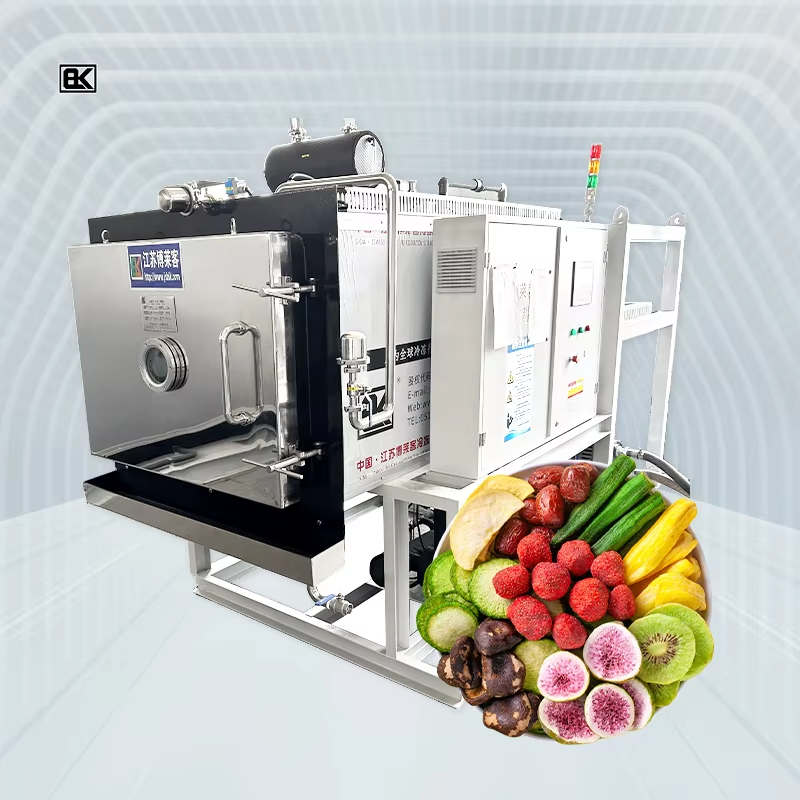
One of the most sophisticated preservation techniques is freeze drying or lyophilization as it is scientifically referred to. In contrast to the conventional drying method, which involves heat to evaporate water, freeze drying involves the freezing of the product, followed by removal of the ice by the sublimation process- transforming the frozen water straight into vapor without going through liquid state. This mild treatment does not change the original shape, color, nutrient content, or taste of the product and maintains it over the years without refrigeration. We have a history of producing freeze drying equipment at Jiangsu Bolaike Refrigeration Science and Technology Development Co., Ltd. of more than 20 years. The following is a step wise description of the working of a freeze dryer.
1. The Freezing Stage: Turning Moisture into Solid Ice
Freezing is the initial step in freeze drying. The product is put in the shelves within the vacuum chamber and the refrigeration system quickly reduces the temperature to a temperature below the eutectic point of the product; normally -40 oC or colder. This is the temperature at which all moisture in the product is in the form of solid ice crystals. Freezing speed and uniformity is important. The slow freeze forms big ice crystals which may cause damage to cell walls and therefore leave the food coarse and spongy. Quick freezing, without large ice crystals, leaves minimal crystals, which maintain the original structure of the product. The freeze dryers of Jiangsu Bolaike have advanced refrigeration systems, thus ensuring that all shelves are frozen in the same manner leading to the high quality of results each time the batch is produced.
2. Primary Drying (Sublimation): Removing Ice Under Vacuum
When the product is completely frozen, the vacuum pump is turned on and the pressure in the chamber is lowered to an approximation of vacuum (usually less than 100 Pa). The shelves are then gently subjected to heat. In such low pressure conditions, the frozen water (ice) would sublimate- it becomes water vapor without melting. The vacuum system pulls the vapor out of the chamber and condenses it on the cold condenser coils (which are even colder than the product). This initial drying stage eliminates most of the moisture content, usually 90-95% of the total moisture content. The product does not shrink, harden or lose its structure due to the absence of liquid water. The systems of Jiangsu Bolaike are very specific in maintaining the temperature and pressure to achieve the maximum speed in sublimation without melting the product.
3. Secondary Drying (Desorption): Removing Bound Water
Once a product is dried, there is always some water molecule bound to the product but it was not frozen as ice. These are attached by the attraction of the solids of the product by the molecules. Secondary drying increases the shelf temperature (usually +20C to +50C) without vacuum and does so without vacuum. This extra energy ruptures the molecular bonds and the rest of the water is able to desorb (evaporate) off the product. The secondary drying process eliminates the total residual moisture to 1-4% based on the product. It is this ultra low moisture content that makes freeze dried products have an astonishing 20-30 year preservative free shelf life. The programmable logic controllers (PLCs) at Jiangsu Bolaike have a programmed switching of secondary and primary drying according to the temperature and pressure of the product.
4. The Condenser and Vacuum Systems: Capturing Water Vapor
Freeze drying is possible because of two supporting systems. The refrigeration system drives the condenser too, which is a bunch of cold coils within a separate chamber. The temperature of the condenser is kept at -40°C to -85 °C even lower than the product. When water vapor is exited through the product chamber it immediately freezes onto the condenser coils in the form of ice. The condenser helps to avoid the destruction of the vacuum pump by water vapour. The vacuum system (roughing pump and/or high vacuum pump) is used to remove non condensable gases (air, nitrogen) in the chamber to ensure the low pressure required during sublimation. Once the cycle has been completed the condenser is heated to melt the ice and it is drained out. Jiangsu Bolaike develops energy efficient vacuum and condenser system, which minimizes cycle time and electricity.
Conclusion
A freeze dryer is a three-stage process: freezing (converting moisture into ice), primary drying (sublimation of ice to vapor in a vacuum), and secondary drying (removal of bound water). The vacuum system ensures low pressure and the condenser traps down water vapor. This soft procedure maintains the color, nutrients and taste over decades without refrigeration. Jiangsu Bolaike produces household, laboratory, pharmaceutical, and food freeze dryers with more than 20 years of experience, ISO9001 and CE certifications as well as 56+ patents in China. Call us now to get to know more or visit the factory in Changzhou, China.