 EN
EN

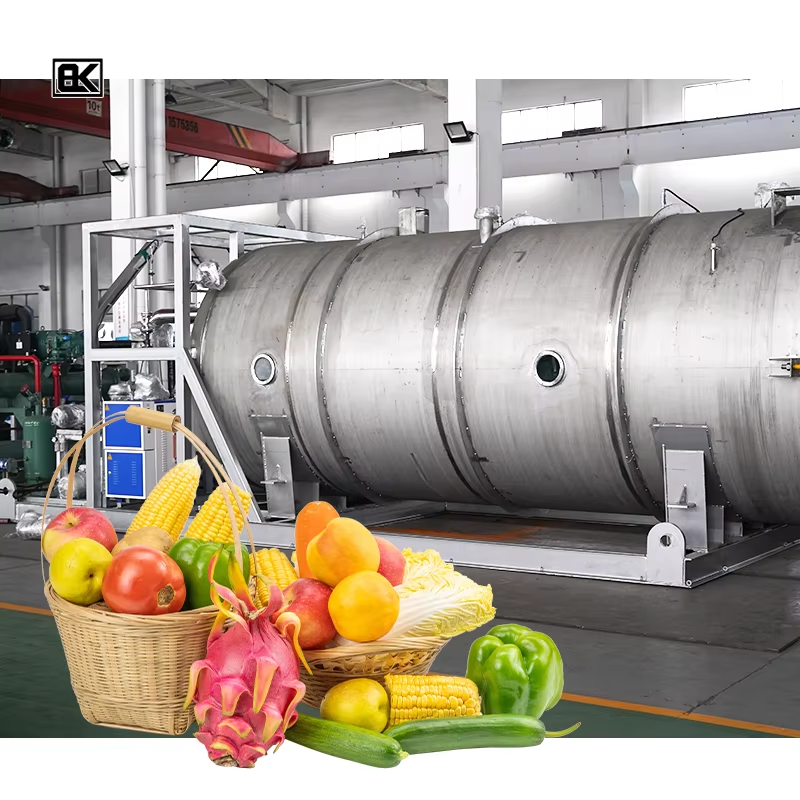
Freeze drying (lyophilization) is an elaborate industrial practice that eliminates moisture and maintains the structure, color and nutrients of the product. Whereas small DIY freeze dryers can be constructed as educational equipment, commercial grade machines are engineered to precision, have a strong refrigeration system, and are closely monitored regarding quality. We have been producing freeze drying equipment (home appliances to large-scale food and pharmaceutical production lines) of more than 20 years in Jiangsu Bolaike Refrigeration Science and Technology Development Co., Ltd. The following is a description of the construction of professional freeze dryers.
1. The Core Components of a Freeze Dryer
There are four basic systems in every freeze dryer, no matter its size. The refrigeration system freezes the product and condenses water vapor in the condenser coils. Vacuum chamber eliminates pressure, and the ice vaporizes directly into vapor. The heating system delivers the controlled heat that is gentle enough to push the sublimation and does not melt the product. Lastly, temperature and pressure are monitored during the control system. The Jiangsu Bolaike engineers every one of these systems in such a way that they are energy efficient and reliable. Its refrigeration system incorporates industrial grade compressors; the vacuum chamber is made of stainless steel to resist corrosion, the heating system is made of silicone oil or electric blankets to ensure even heat distribution, and the control system incorporates programmable logic controllers (PLCs) to automatically control the system cycles.
2. Sizing and Designing the Vacuum Chamber
A freeze dryer consists of a vacuum chamber. It should be able to resist the outside atmospheric pressure (14.7 psi) and have a near vacuum in the interior. In small laboratory and domestic freeze dryers (0.5-5 m2 shelf area), the chamber is made of welded stainless steel in the form of a cylinder with a hinged door and sight glass. In large food and pharmaceutical freeze dryers (30-200+ m2 shelf area) the pressure vessel is a rectangular or cylindrically shaped pressure tank with several shelves, a loading door, and an independent condenser chamber. All surfaces of products at Jiangsu Bolaike are in contact with food grade 304 or 316 stainless steel. The design of the chamber should also be in such a way that it has the capability of providing even temperatures at the shelves, cleaning (CIP systems in pharmaceutical models) and also should have less thermal bridges that consume energy.
3. Manufacturing the Shelf and Condenser Systems
The product trays are stored in shelfs and heat exchanged in the drying cycle. In industrial freeze dryers, shelves consist of hollow plates with a circulation of a heat transfer fluid (silicone oil). The shelf system should be as flat as possible so as to have a uniform drying process on all trays. The condenser is a series of coils (usually of stainless steel) which freeze water vapour extracted into the chamber. To ensure that all the moisture is captured, the condenser has to attain temperatures of -40°C-50°C or even less. The manufacturing process of Jiangsu Bolaike involves precision machining so that the shelves can be flat within 0.5 mm. Our condensers are constructed in such a way that they can be readily defrosted between cycles, reducing downtimes. In the case of pharmaceutical models, we incorporate CIP (clean in place) nozzles in the chamber and condenser.
4. Quality Control, Testing, and Certification
To freeze dryer is not merely a matter of collecting components, but more to do with quality of performance and safety. All machines are highly tested before they leave the factory. The vacuum system is also checked to be leak free (vacuum at least 24 hours). The refrigerator is checked in the cooling rate and end temperature. The heating system is experimented on the consistency of all shelves (usually within 1oC). Lastly, a complete freeze dry cycle is performed with water or a product surrogate to check on cycle time and final moisture content. The 12,000 m2 factory of Jiangsu Bolaike is run on ISO9001 quality management and our machines are CE certified to be exported to Europe, Asia and the Americas. Our engineers have 56+ national patents and constantly enhance each element, including more efficient vacuum pumps, and more intelligent control software.
Conclusion
Professionally freeze drying involves refrigeration, vacuum, heating and control systems that are engineered with precision. The vacuum chamber should resist atmospheric pressure; shelves should be 100% flat; condensers should be -40 oC or below and all of the units should be tested to ensure that they have no leaks or performance defects. Jiangsu Bolaike has more than 20 years of experience in producing household, laboratory, pharmaceutical and food freeze dryers with a factory area of 12,000 m2. Call us now to inquire about your freeze drying requirements or have a factory tour in Changzhou, China.